





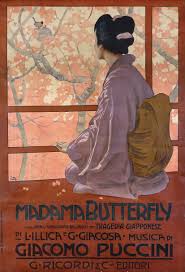
Libretto
Giuseppe Giacosa and Luigi Illica, after the play Madame Butterfly by David Belasco
First performance
Milano, Teatro alla Scala, 17 febbraio 1904.
Synopsis
Goro, the marriage-broker, shows Lieutenant Pinkerton the house where he will live with Cio-Cio-San, after their marriage, and introduces the servants. Pinkerton explains to the consul Sharpless, who has joined him, that he has the house on a long lease, to be terminated at a month’s notice: his coming marriage is to be undertaken on similar terms, since he has no intention of continuing the relationship. Cio-Cio-San and her family arrive and the wedding takes place, interrupted by the Bonze, who curses her as a renegade. The company disperses, leaving Cio-Cio-San and Pinkerton alone together, as evening draws on. Three years later she awaits still the return of Pinkerton, who has never seen the son she has borne him. Attempts are made by Goro to bring about another marriage, to Prince Yamadori. Eventually Pinkerton does return, having prepared Sharpless by a letter. He brings with him his American wife, and Cio-Cio-San kills herself with the knife that her father had used for his own death by imperial command.
Madama Butterfly became real the moment Puccini attended a performance of David Belasco’s play Madame Butterfly in London on June 21, 1900, during his visit to England for the first performance of Tosca. Impressed by the play, a few months later he asked Ricordi to obtain the rights to the opera. The libretto was once again entrusted to Luigi Illica and Giuseppe Giacosa.
Puccini decided to eliminate an entire act of the play, the so-called “consolate act.” The first draft date back to November 1901. Significantly, in several letters, the composer expressed a desire to delve deeper into traditional Japanese music, aiming to give an authentically oriental feel to his first exotic opera.
Puccini continud to work on the opera in 1902, but a serious car accident (February 25, 1903) forced him into a long period of immobility and medical treatment. The date of the first performance was postponed.
The first performance was a major failure, prompting Puccini, Ricordi, and the librettists to immediately withdraw the opera. Months of changes, cuts, additions, and revisions followed. Despite this difficult start, Madama Butterfly returned to the stage in Brescia on May 28, 1904, finally achieving the success that would later become worldwide.