




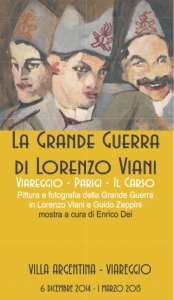
Exhibition: VIAREGGIO – PARIS – THE KARST
Depictions and photographs of the Great War by Lorenzo Viani and Guido Zeppini
Viareggio Villa Argentina 6 December 2014 – 1 March 2015.
The exhibition forms part of the events marking the centenary of the First World War and aims to commemorate its victims from Viareggio; some 397 young men who set off in their uniforms, and their families who would never see their sons return, killed in what rhetoric refers to as the field of honour.
The exhibition is intended to pay homage to the town of Viareggio and its war victims, celebrated and remembered through the artistic contribution of Lorenzo Viani and camera lens of the frontline doctor Guido Zeppini.
The Great War is the stage of this exhibition with the most important Italian expressionist Lorenzo Viani and medical captain Guido Zeppini as protagonists.
Viani paints and draws scenes of civilians caught up, unwillingly, in the armed madness; nameless and humble privates fighting in bloody battles by no choice of their own. Guido Zeppini, born in Pontedera in 1875 and graduated in medicine in 1900, was a highly regarded doctor in Viareggio, famous for being one of the founders of the Umberto e Margherita Territorial Hospital, later called Tabaracci, of which he was director in 1916. Numerous war wounded from different zones were treated in Viareggio’s hospital. From the annals of the time: 14 August 1915, at 2.40am, a train with around 200 war wounded arrived in Viareggio; unfortunately, this will not be the only train loaded with sufferance to arrive in Viareggio. Zeppini exempted from military service for being over forty, struck by so much pain, and in order to do his bit, asked and obtained a transfer to a battle zone at the front as a doctor (to be precise in Ronchi dei Legionari), where he directed a military hospital. His participation and human commitment were such that he was awarded important recognition: the Medal of Valour, the Medal of Freedom of the Italian Red Cross (C.R.I). He also received a certificate of merit from the same C. R. I. and a formal commendation from the Command Corps of Florence. Also being a good photographer, at the front he immortalised chronicles of scenes of soldiers, camps, carnage, trenches, ruins of civilian homes bombed by the enemy and other lesser known events of war. Zeppini, figure of a certain social standing and highly regarded in Viareggio, was aquainted with regular intellectual visitors of the town, including Sem Benelli and Primo Conti. His family, also known within artistic circles, were admirers of the expressive art in the town, so much so that Zeppini’s daughter received a Viani painting as a wedding present in 1936. The family also owns an expressive xylography by the Viareggio Master, that the painter’s widow, Giulia Giorgetti, donated to the Zeppini family.
The iconographic – documentary part is enriched with a series of memorabilia regarding Viani and Zeppini, and others donated by the families of the soldiers who were conscripted from Viareggio and the surrounding areas.
The exhibition can be interpreted on different levels:
– the aspects strictly celebratory connected to the tragic centenary of the Great War
– the more intimate and introspective aspect connected to the local area and to the real protagonists – the list of war victims constitutes the exhibition’s initial impact, where visitors can read the names of known people and families
– the documentary, historical and journalistic level, represented by Zeppini’s photographs and Viani’s letters from the frontline: images of dead soldiers, scenes of war and depictions of cemeteries
– the artistic level, closely tied to the chronicles, from Viani’s sketches and charcoal drawings, often on scrap materials: portraits of soldiers outlined with few traits, profiles of men who at first glance seem like bullets.
Details:
dettaglio