




Libretto
Ferdinando Fontana, after the poem La Coupe et les lèvres (The Cup and the Lips) by Alfred de Musset
First performance
Milan, Teatro alla Scala, 21st April 1889
Trama
Edgar loves the village-girl Fidelia, but is seduced by his desire for the Moorish Tigrana, whom he defends and with whom he escapes the village, after wounding Frank, Fidelia’s brother, in a fight. Joining the army, he seeks to make good his name, but in the third act his funeral is celebrated, with Frank and a cowled monk standing before the coffin. The latter expatiates on Edgar’s sins and the angry crowd opens the coffin, which contains only armour. The monk now reveals himself as Edgar and embraces Fidelia, who has remained loyal to him. She, in turn, kills Tigrana.
The success of The Willis convinced publisher Giulio Ricordi to take Puccini under his wing, offering him a steady monthly salary of 200 lire, and entrusting him with the creation of a new opera, Edgar.
The composer spent about four years writing the opera, a period also marked by the beginning of his relationship with Elvira Bonturi and the birth of their son, Antonio.
The first performance was not as successful as Puccini and Ricordi hoped and only two more performances followed, a sign of the lack of public response.
Encouraged by Ricordi, Puccini immediately revised the opera, with the idea of a future revival. This did not happen until September 1891 at the Teatro del Giglio in Lucca, where the opera finally achieved considerable success.
The success in his hometown prompted Puccini to redefine the opera’s structure: he cancelled the fourth act entirely and significantly shortened the second, thus creating a new three-act version. This revision was performed in 1892 in Ferrara, Turin, Madrid, and Brescia.
A third revision was conceived for the “Puccini Festival” in Buenos Aires in 1905, but even then the result was not particularly satisfactory.
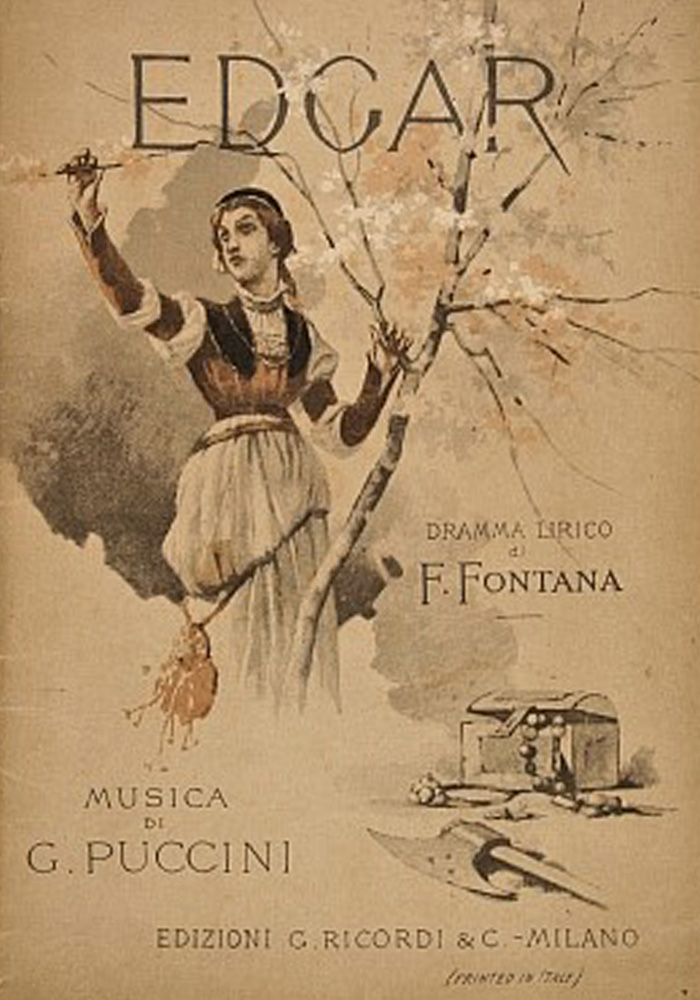
Libretto (cover): Archivio Puccini Museum.