



A charming walk (but the route can also be tackled by bicycle thanks to the convenient cycle path that runs along both Via Catalani and Viale Puccini) among Art Nouveau architecture, just outside the historic center of Lucca.
move mouse over a track or select one in control panel ...
Stops:
Leaving Porta Vittorio Emanuele II (1911) behind us, we head towards Viareggio along Via Catalani, where at number 24, on the intersection with Viale Lazzaro Papi, we find a villa built in 1915 based on a design by architect Giovan Lelio Menesini.
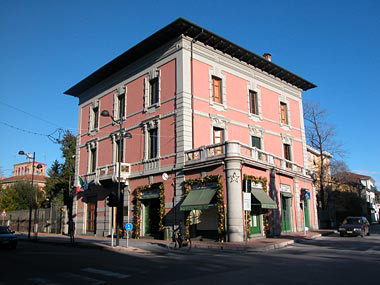
At numbers 100/116/122 are Palazzo Maso and the former Automobile Cooperative garage, built in 1912/1914, by architect Giovan Lelio Menesini.
Also noteworthy are the buildings marked by numbers 81/87 and 167, which feature a traditional layout, but with an eclectic decoration.
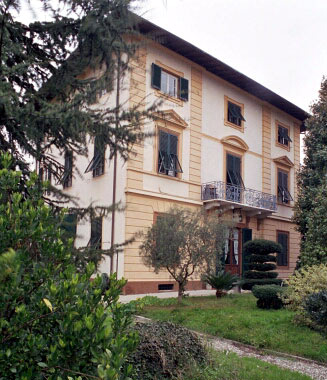
The villa at number 135 is designed on the classic Tuscan cube model; to the rear, on Via Gemignani, it is flanked by a twin villa.
The villa at no. 136 features eclectic motifs, with a profusion of decorative concrete elements. The main door is particularly original, decorated with ornamental elements in the form of garlands and palmettes and surmounted by the monogram PB.
Finally, at no. 158 we find the Martini villa, built in 1912, also by architect Giovan Lelio Menesini.
After the church of Sant’Anna, which today features the 1932 redesign by architect Gaetano Orzali, and continuing towards Viareggio, on Viale Giacomo Puccini at number 75 we find Villa Lazzeroni, built in the early 20th century by the Orzali Company.
Buildings from the first two decades of the 20th century enliven this street at numbers 143, 142, 156, 170, 251, and 254, which feature a traditional 19th-century layout and decoration.
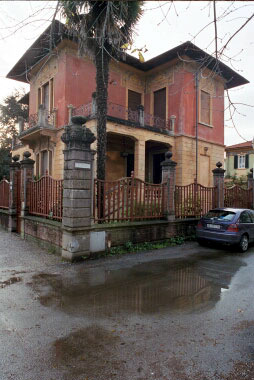
At number 400 is a small villa, noteworthy for its external staircase leading to a loggia with Ionic terrazzo columns surmounted by a terrace. The layout of the villa is, as always, traditional, as are the decorations.
The layout of the villa at number 400 is also traditional, but the modernist taste shines through.
Immediately next to it, at no. 467, stands a charming villa adorned with a interesting paintings and concrete brackets. Below the band, three decorative panels, alternating with the windows, depict two deer feeding on the leaves of a tree, enveloped in a sunset atmosphere with a Symbolist influence.
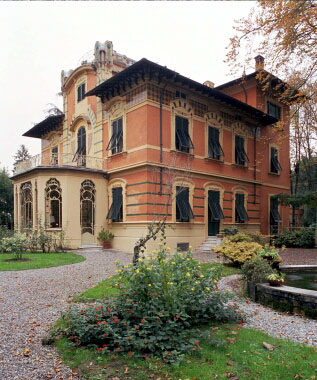
The villa at no. 527 is also interesting. It is embellished with a graceful turret-shaped bow window on the corner and is adorned with a eaves band with panels underneath, the whole decorated with chrysanthemum motifs on a starry blue background in an Orientalist style.
At 548 we find Villa Martinelli Caprotti, redesigned and expanded at the beginning of the century by Frediani. Nearby, once connected to Viale Puccini by a small driveway, is Villino Jole, designed for himself by Arturo Caprotti in 1912, which today overlooks Via Paganini at number 76.
Walking along on Viale Puccini, at numbers 588/510 we find Villa Cortopassi, with its eclectic decoration, featuring concrete elements and a geometric-patterned eaves cornice.
At number 643, on an irregular plan, stands a small villa characterized by its entrance loggia overlooking both Viale Puccini and Via Ferraris.
Next come the villas at numbers 712 and 738, both built according to a traditional plan; the latter is more distinctive, both for its corner entrance, a loggia surmounted by a terrace, with a stylized faux ashlar covering the entire ground floor, and for the decorative concrete bands featuring geometric, spiral, and floral motifs.
On the corner of Via Don Sturzo is the Regina Margherita school, a notable building with a Greek cross plan. The arm parallel to Viale Puccini is highlighted at the corners by pilasters. The section facing the street rises as a turret, which serves as the entrance hall with two symmetrical doors. On the front, a Carrara marble plaque commemorates the fallen of World War I. The plaque sits on a high plinth and is surmounted by a broken pediment supported by corbels, all made of Matraia stone. Above is a niche in the shape of a triumphal arch decorated with swords and oak branches. The tower is crowned by the stone coat of arms of Lucca, which bears traces of the carved fasces. On the arms parallel to the road are two plaques with the names of the fallen.
Finally, noteworthy at number 1745 is the elegant Villa Chelini, built in 1909.
Details:
- GIUSTI MARIA ADRIANA (a cura di), Le età del Liberty in Toscana, Octavo Franco Cantini editore, 1996
- NICOLETTI N., Le residenze fuori dalle mura, in Il Museo per conoscere. Esperienze e proposte , a cura della Soprintendenza B.A.A.A.S. delle province di Pisa, Lucca, Massa Carrara, Livorno, Sezione Didattica dei Musei Nazionali di Lucca, anno II, n.3-4, Maria Pacini Fazzi Editore, Lucca 1995
Information:
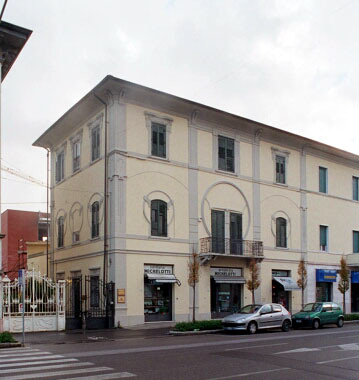
Start: via Catalani, 24 (on the intersection with viale Lazzaro Papi)